Barriers to Philanthropic Equity Part 1: Accessibility

How grant applications can create obstacles to fundraising
By AJ Loper
In an ideal world, every fundraiser and organization would have equal access to resources, networks, and information to serve their communities. Research and experience tell us that this is not the case. We actually have a lot of ground to make up in terms of accessibility and equity in the philanthropy space, but until we acknowledge these gaps, they will remain. The question is, will we ignore them and step over, or will we fill those holes for the next generation of fundraisers?
This three-part series will navigate the most explicit hurdles fundraisers face while trying to do the work. From burdensome application processes to power imbalances to a scarcity mindset, the menu of disadvantages is replete with high costs that deal a blow to our nonprofits and the communities they serve. It will not be a single-entity initiative, but a collaborative, trust-building effort.
The Accessibility Barrier
To understand what equity looks like, we first need to paint a picture of the barriers to it, which begins with access. Case in point: The Walmart Spark Good community grants. According to their website, Spark Good is the “force multiplier,” but what we’ve seen in our own grant curation is that the only thing it multiplies is the work required to apply.
If you haven’t submitted an application for this specific grant, let me set the scene. For starters, fundraisers are charged with creating a Spark Good account. This is an account they will need to verify before moving forward. It took one of our senior grant writers approximately 1.5 working days to authenticate a nonprofit client’s credentials.
Once finished, you are all set up to start searching for the available grants, right?
Wrong.
Even though you’ve signed in as a trusted user working at or for a nonprofit organization, you still have to set up your organization’s profile in Spark Good. And, make sure there’s a profile photo (*required) and a logo (*required). And, also, you’ll need to wait another 24 hours before all of this work is vetted and approved by the Walmart oligarchy.
But now, your profile is set, and you can officially wade gloriously through the grant prospects. Right? Right?!
Wrong again.
Welcome to Deed! The most recent addition to the Walmart grant overhaul (circa February 2024). Sigh.
After all the rigamarole with Spark Good, your work is not done. You’ll now have to create an account on Deed to continue through the process. Hang in there; those juicy grants are right around the corner…
Pro-tip: When you confirm your organization on Deed, ensure you have a user and at least one backup user set up, or use a generic organization email (like info@MYORG.org) that multiple people can access. Only authorized users of the organization’s Spark Good account may apply.
For those following along:
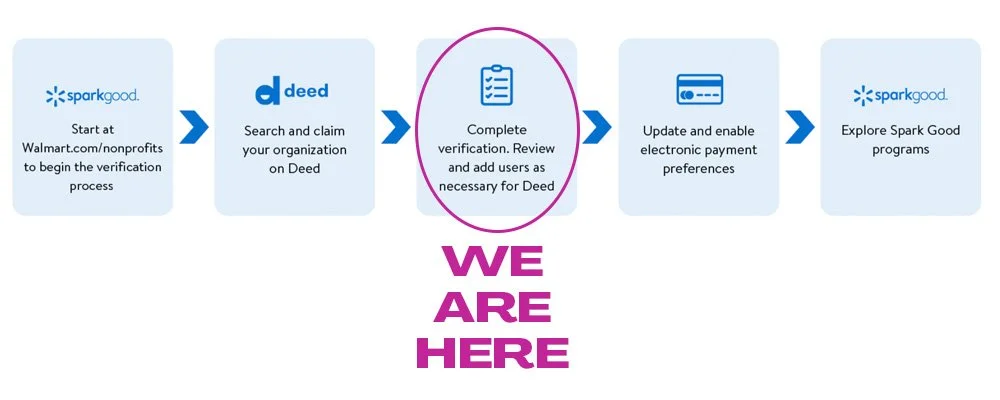
To review: We have a Spark Good account (✅) and a Deed account (✅), and we are on our way to searching those grants. And if you are hoping the foolishness stopped here, saddle up! You now have to create a PayPal account for your organization. Why? Because if you do win a grant via Spark Good, it’s the only way you will get the money.
All of this, in the hope of securing a grant of up to $5,000. Maybe. If there’s one open in your Walmart area, that is. Whether Walmart funding opportunities are available to you at this point or not, this process requires an exhausting amount of time, effort, and sanity in the name of fundraising. (If you have to have videos to explain your process, that doesn’t extend a lot of confidence.)
On a positive note, our grant writer was delighted to learn that, once you get to it, the application consists of only eight questions (score one for accessibility, sort of). And at least we were able to click the submit button successfully (we’re looking at you, GEICO Foundation).
Good Intentions Vs. Execution
Trust-based philanthropy is a set of guidelines and principles that aim to rebalance power through stronger relationships, collaboration, and mutual accountability. But in order to have trust, we have to understand intention. Is it the intention of the funder to provide grants in a fair and transparent way? And can we ever really know those intentions for certain? The only thing we have to go on is execution.
So what does good execution in accessibility look like? According to this article from Candid, the two key pieces are process clarity and modeling practices that are already working. Kaerie Ray, curator and communications officer with Candid, explains that following these steps in the process can make a substantial difference:
Simplify the grant application.
Offer additional support.
Diversify and train the reviewer pool.
Implement anonymized reviews.
Provide feedback for unsuccessful applications.
“The sector as a whole benefits from funders addressing any unintended biases in grant application and review processes that can run counter to their missions,” Kaerie Ray writes. “Process improvements take time, but steady progress keeps the goal in sight and achievable.”
But that’s not all. Danielle Allen, with the National Center for Family Philanthropy, writes it’s not enough to put your grant on the internet and hope for the best.
“If your application is online and open to all, you’re still not off the hook. Every minute that your grantees spend combing the internet for funding opportunities is a minute they are not spending in service of their mission. It shouldn’t be the sole responsibility of the grantee to find you. How do you make sure word gets to your desired applicants?” said Allen.
The biggest takeaway? Always strive to change for the better; this is where intention is born.
While it is easy to fall into a web of finger-pointing and blame, highlighting bad examples and becoming haughty about our own good work is neither the goal nor the solution to accessibility. As Kim Scott, author of Radical Respect, writes, “Looking for the ‘bad guy’ can feel satisfying because it indulges the instinct of self-righteous shaming. But it’s dangerous because it offers a false reassurance that the problem is all someone else’s fault and there’s nothing we can or should do about it.”
In the end, we are all responsible for this work. It is our duty not to look solely for problems in our sector but to look toward progress, to develop solutions that address these barriers. That is intentionality.
Shaady Salehi, executive director of the Trust Based Philanthropy Project, said in this article, “Being intentional means putting yourself in the shoes of those who are going through the grantmaking experience,” Salehi said. “Streamlining is a key part of trust-based philanthropy because there are a tremendous number of hurdles that burdensome applications and reporting create for nonprofits.”
We have all witnessed the increasing strain on today’s nonprofits' infrastructure; hurdles are not something fundraisers have time for. Many fundraisers don’t have the resources or time to create superfluous accounts, verify them, add marketing and graphic design flair, upload profile photos, search for logos, etc. Forget the barrier; these practices create walls between our communities and those who hold the power. It is the definition of inequitable.
It would be prudent for us all to take a second look at the practices that unfairly burden the most vulnerable members of our population. And even if grant funders miss the mark on their first attempt, we should all hope that would be an even greater reason to keep trying.
If grants are going to continue to be a key component of the nonprofit world – one way in which organizations can keep programs running and serve communities – we must advocate for better practices.
Novelist Oscar Wilde put it simply: "It is always with the best intentions that the worst work is done."
That is, of course, if the intentions are actually good.
Where Do We Go from Here
There’s nothing naive or wrong about believing that grant funders are motivated by good intentions. In many cases, that belief is a form of self-preservation—it allows the work to move forward. At the same time, real progress toward equity requires us to name and examine the gaps created by poor practices. We can achieve this by identifying what’s working while also raising the bar for all funding practices. This is the first barrier to address—and the first step—on the path toward philanthropic equity and inclusion.
Check back for part two in our Barriers to Philanthropic Equity Series, coming in January, when we will examine the cultural and systemic roadblocks fundraisers face.