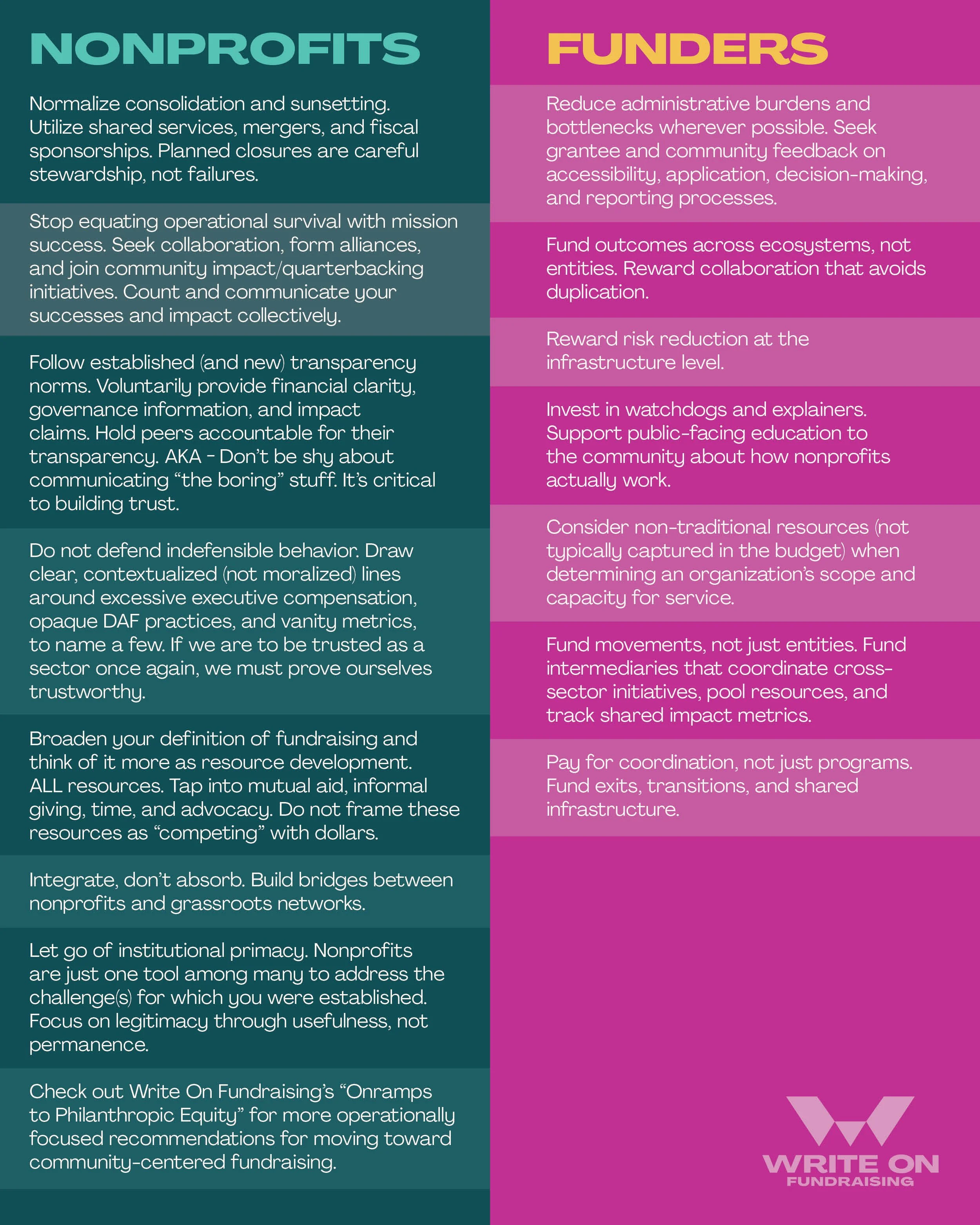
Policy Agenda
Why We Advocate for Policy AND Systems Change in Philanthropy
The nonprofit sector is facing a convergence of crises that better fundraising tactics or marginal policy tweaks cannot solve. Trust in nonprofit institutions is at a historic low. Individual giving participation continues to decline. Meanwhile, unprecedented amounts of charitable capital are accumulating in tax-advantaged vehicles, removed from communities and delayed from public benefit.
This moment demands more than adaptation at the organizational level. It demands policy and systems change.
At Write On Fundraising, we believe the purpose of philanthropy is not to preserve institutions, wealth, or legacy vehicles - but to move resources into communities in ways that are timely, responsible, and equitable. To “change how funds are raised,” as you may have heard us say, means committing to public policy and systems change priorities that are rooted in that belief.
Public Policy Priorities
Immediately accelerate the movement of charitable resources to nonprofits by building a broad donor base and dismantling structures that warehouse wealth, entrench philanthropic dynasties, and delay public benefit.
Restore public trust in nonprofit work by establishing practices that prioritize collaboration with people, collective impact, and equity over the preservation of institutions.
Support the long-term health of the nonprofit sector by safeguarding fundraisers from exploitative practices, expanding recruitment pipelines, and retaining skilled talent through professional standards, fair treatment, and career development opportunities.
Our top priority is simple: get more charitable dollars into nonprofits - faster. Right now, apart from individual donors, the federal government, private foundations, and donor-advised funds control the majority of resources meant for charitable purposes. These are the levers we focus on in our policy work.
DAF (Donor-Advised Funds) holders receive immediate tax benefits but can withhold funds indefinitely, delaying public benefit and wealth-hoarding hundreds of millions of dollars from the nonprofits for which they were intended.
Write On Fundraising advocates for DAF regulation through:
Delayed tax deductions. Donor receives a tax donation when funds are granted from the DAF to a nonprofit organization (rather than from the donor to the DAF, as currently structured).
Time limits on principle. Require all funds to be paid within a specific period of time from when they were gifted to avoid wealth-hoarding and perpetuity philanthropy.
Mandatory minimum payout requirements. Require DAFs to distribute an annual minimum of their principal balance or incur heavy taxes and penalties.
Greater transparency. Implement reporting and publication requirements for DAF fund balances, grant recipients, and payout timelines.
While private foundations hold billions in charitable assets, long-term accumulation delays public benefit and concentrates wealth rather than putting resources to work in communities today.
Write On Fundraising advocates for private foundation reform through:
Increased minimum payout. Significantly increase the private foundation payout and increase the flow of fundraising immediately.
Enforcing time limits on principal balance. Discourage perpetuity by establishing a minimum distribution timeline. Levy a wealth tax on any private foundations that do not comply.
Directing more funding toward nonprofit organizations by disallowing certain administrative expenses, like staff salaries, from counting toward payout.
Incentivizing higher payouts. Provide tax credits or reduced regulation (like the excise tax on net investment income) for private foundations distributing more than double the established minimum distribution.
While federal programs allocate significant funding to nonprofits, administrative delays and red tape keep resources from reaching communities quickly, reducing public benefit.
Write On Fundraising advocates for government grant reforms by calling for:
Streamlined grant applications and reporting templates across all agencies to decrease the amount of time nonprofits are expected to invest in narrative development and reporting. Reduce the number of reports, or consolidate reporting for multiple programs.
Flexible and unrestricted funding by offering more multi-year, flexible grants that can be allocated to community priorities. Allow for a greater portion of grants to fund overhead, infrastructure, and capacity-building.
Reducing administrative barriers for smaller or grassroots nonprofits by creating simplified grant tracks, providing technical assistance, and streamlining procurement and contracting requirements.
Encourage faster, more predictable payments by standardizing payment processes across agencies to reduce inefficiencies and confusion. Accelerate disbursement schedules and allow upfront and/or partial payments.
Why doesn’t Write On advocate for changes to the standard deduction?
Great question. Many philanthropy reformers include individual tax policy in their priorities. While we believe that the decline in individual giving participation correlates with the rise of the standard deduction, the continuous drop in giving is far more likely caused by declining trust in the philanthropic sector, continued dismantling of the middle class, and cultural shifts around what it means to give.
The standard deduction likely reinforced - not caused - those trends, and we do not believe changes to the standard deduction would prove to be the “silver bullet” that others have championed it to be.
For context, consider the Lilly School of Philanthropy’s estimate that the standard deduction will lead to a decline of $4.1-$8.5 billion from high-income households over the next ten years, while DAFs held $326 billion as of the end of 2024 and grew by $75 billion in just one year. The standard deduction is not the problem.
For the first time in recorded history, nonprofit institutions have lost the public’s confidence to corporations.
This erosion of trust is more than a perception problem - it has real consequences. When donors, volunteers, and policymakers hesitate to engage, critical resources are delayed, programs falter, and communities that rely on these services suffer. Trust is the currency of the sector, and without it, even the most well-intentioned organizations struggle to deliver meaningful impact.
Restoring trust requires more than marketing or glossy reports. It demands systemic changes that prioritize collaboration, collective impact, and equity over institutional self-preservation. Nonprofits must demonstrate accountability, transparency, and alignment with the communities they serve, sharing successes and failures openly, coordinating to reduce duplication, and distributing decision-making power rather than concentrating it at the top.
By establishing sector-wide norms that reward openness, shared governance, and equitable resource distribution, the sector can rebuild credibility and show the public that its primary goal is community benefit, not institutional survival.
Write On Fundraising advocates for building trust in the nonprofit sector by supporting legislation aimed at:
The creation of a federally-run portal for nonprofit data offered freely to the public, where organizations above a certain revenue threshold can easily upload and share executive compensation, financials, and program outcomes in standardized, accessible formats, as well as other voluntary information.
Utilization of this portal to encourage collaborative reporting so the public sees nonprofits working together rather than competing for attention or dollars.
Rewarding nonprofits that adhere to rigorous governance and impact standards with reduced reporting burdens and/or early access to federal/state grants.
Strengthening IRS or state enforcement on nonprofit compliance, particularly for excessive executive compensation, private inurement, or mismanagement of funds.
The provision of grants or tax incentives exclusively for multi-organization partnerships that demonstrate community-wide impact.