Navigating the Scarcity Mindset Economy: From Survival to Systemic Change

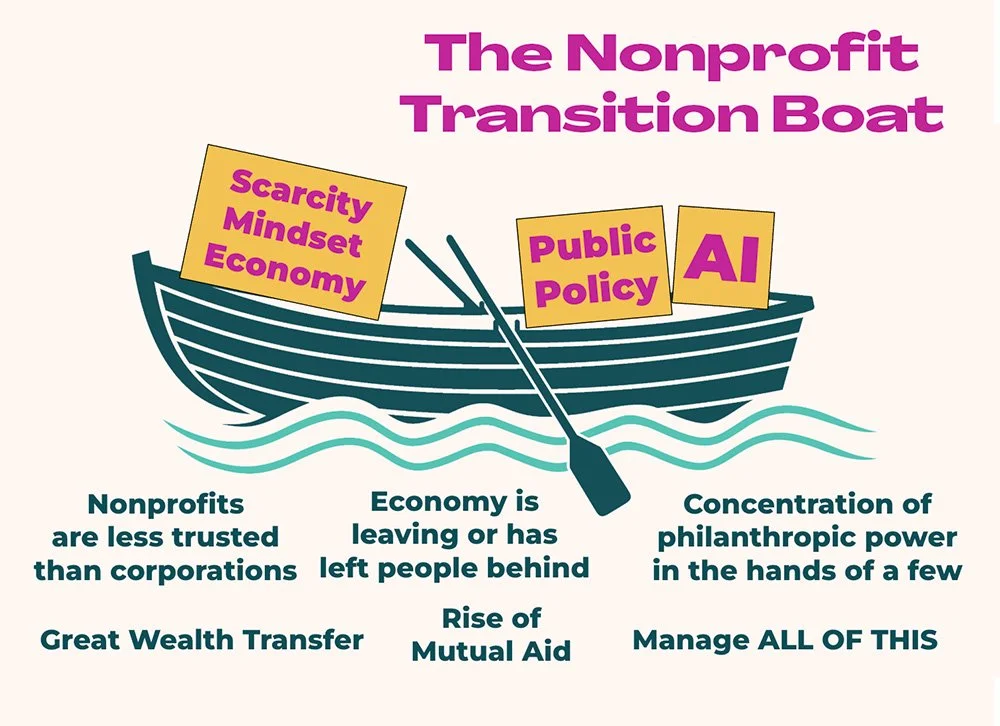
Nonprofits have found themselves on the metaphorical boat of transition; what comes next?
I have a serious question: Are nonprofits OK? Let’s check the emails...
If your inbox looks anything like mine, it is a non-stop barrage of webinars and articles broadcasting a singular, exhausting theme:
Reducing Fundraiser Burnout in an Uncertain World
Adapting Your Fundraising Strategy in an Uncertain Economy
Fundraising in Shifting Landscapes and Uncertain Times
"Uncertain" has rapidly become the new "unprecedented." It is a term that breeds helplessness, leaving nonprofit leaders wondering if we are playing by the old rules, some newfangled rules, or no-holds-barred, cage match rules.
I’m more inclined to say that we are actually quite certain. We are certain that event attendance never truly recovered after the pandemic. We are certain that competition for funding has never been fiercer. And we are certain that there are fewer individual donors participating in philanthropy today than at almost any point in modern history.
We are not living in "uncertain times." So, where are we? Let’s discuss.
Row, Row, Row Your Boat
We have found ourselves on the metaphorical boat of transition. We have pushed off from the shore, but we cannot yet see where we are going and what the waters look like. In this space, a scarcity mindset has taken hold. (You’ve heard the phrase a smooth sea never made a skilled sailor? Well, after this voyage, we will all be admirals of our fleets.)
This scarcity mindset is the belief that our resources—money, time, attention, or goodwill—are fragile and easily lost. It forces decisions that prioritize short-term survival and protection over long-term investment and collaboration.
But when this psychology extends outward, the ripple effects create a broader systemic condition where economic, political, and philanthropic structures are actively organized around the assumption that resources are unstable. Welcome to the Scarcity Mindset Economy.
This is a place where chronic competition has become the default. Nonprofits are scrambling for shrinking donor pools, communities fight for limited public funding, and funding instability becomes the norm through shorter grant cycles and unpredictable revenue streams. Risk-avoidant behavior is rewarded, wealth is concentrated in fewer hands, and trust-based partnerships are put to the side.
Before we can navigate this transition, we must first acknowledge exactly where we are. In Oklahoma, the data tells a stark story of this shift:
There are now 21,000 registered 501(c)(3) organizations in our state.
In 2020, there were 4,800 active fundraising organizations; by 2025, that number surged to 6,700.
Oklahoma remains one of the poorest states in the nation, facing massive structural challenges in education, healthcare, and child poverty, with 1 in 5 children living in poverty.
While institutions like the University of Oklahoma can raise $334M in a single year (including 60+ million-dollar-plus gifts), this hyper-concentration of mega-gifts masks a steady erosion of everyday, grassroots donor participation.
What does this all mean? Generosity in Oklahoma remains incredibly strong, but the system around it is fractured. We have more nonprofits than ever competing for fewer individual donors in a state where economic pressure limits everyday giving capacity.
The Four Forces Reshaping Our Waters
As we steer this transition boat, pitching and rolling, we are being hit by four massive, overlapping disruptors that are threatening to capsize us:
1. The Capitalization of AI
Artificial Intelligence is incredibly useful for donor segmentation, predictive analytics, and grant research. But its true disruption is structural: AI rewards existing capacity. Large universities, hospital foundations, and heavily resourced institutions can afford to integrate advanced AI seamlessly, vastly widening the competitive gap between them and underfunded grassroots organizations. Furthermore, over-automation risks a total loss of authentic human connection and a shift toward donor optimization over community accountability.
2. Volatile Public Policy
Executive and legislative actions have expanded federal scrutiny of nonprofits and NGOs, particularly those working in immigration, racial equity, LGBTQ+ rights, environmental justice, and DEI programming. Framed as anti-fraud or anti-bureaucracy measures, these initiatives reduce public funding streams, weaken social safety nets, and amplify a false narrative that nonprofits aren't trustworthy—leaving organizations that tackle structural injustice uniquely vulnerable.
3. The Institutional Trust Deficit
The public perception of philanthropy has plummeted. Studies show that large-scale philanthropy is increasingly viewed not as pure altruism, but as a tool for reputation laundering and asserting privilege. Driven by data breaches from misused technology, political criticism, and high-profile scandals, this trust deficit has caused a massive pivot away from formal nonprofits toward mutual aid networks, direct peer-to-peer cash support, and crowdfunding platforms like GoFundMe.
4. Wealth Concentration & Generational Shifts
As inflation, housing costs, and wage stagnation squeeze lower- and middle-income families out of the donor pool, philanthropic power is concentrating in elite networks. This concentration naturally prioritizes "safe," traditional organizations over those serving marginalized populations. Simultaneously, younger generations (Gen Z and Millennials) are rejecting traditional, hierarchical philanthropy entirely, demanding total transparency, values alignment, and direct activism before giving.
From "Donor-Centricity" to Relational Ecosystems
Fundraisers have always worked in high-pressure environments, but the evolution from traditional to modern fundraising is pushing professionals to the brink. To survive and thrive, we must fundamentally drop the concept of "donor-centric" fundraising from the framework.
While originally designed to improve retention, donor-centricity concentrates power in the hands of the wealthy, elevates the comfort of funders over the voices of communities, and relies on emotional manipulation. It is candidate number one for fundraiser burnout, and it needs to be retired.
Instead, we can adopt a relational ecosystem and trauma-informed fundraising. This means shifting our focus from extractive campaigns to long-term community building, recurring giving, and belonging-based philanthropy. We do this with our words, the photos we use, and our partnerships. We do it together.
The Call for Braver Philanthropy
Fundraisers are routinely expected to be miracle workers—emotionally managing donors, predicting fluctuating economies, and enduring toxic organizational behaviors through sheer vibes and determination. And we have been "Midwestern Nice" for far too long.
It is time to look at our system, acknowledge its flaws, and get angry enough to change it.
We are not equal partners in decision-making when less than 10% of private foundations offer truly multi-year general operating support. Nobody solves systemic generational poverty with a strategy that must be re-funded and re-applied for every twelve months.
We are not equal partners when funding to Donor-Advised Funds (DAFs) ballooned from $37 Billion in 2019 to $250 Billion in 2025—and despite donors receiving an immediate 100% tax deduction, the actual distribution rate back into the community sits at just 24%. That is wealth hoarding, plain and simple.
To change the landscape, we must champion systemic, structural policy reforms:
Reforming DAFs: Support legislation requiring mandatory annual distribution percentages for DAFs, and close the loophole allowing private foundations to move money into a DAF just to meet their 5% payout requirement.
Expanding Charitable Deductions: The 2017 expansion of the standard deduction stripped away direct charitable tax incentives for everyday families, costing the sector $16–$20 Billion annually.
Reclaiming Advocacy Rights: We must demystify the Johnson Amendment. Nonprofits routinely avoid policy engagement out of a false sense of fear of losing their tax-exempt status.
Standardizing Grant Applications: We must demand that private foundations adopt a unified, standardized application and reporting form, eliminating millions of hours wasted on administrative work.
We Are the Wayfinders
Systemic shifts can feel demoralizing, but we are not floating aimlessly. Change is entirely possible. Two decades ago, unrestricted general operating gifts represented less than 20% of all foundation giving. Today, because leaders spoke up and challenged the "overhead myth," that number has doubled to nearly 40%.
We have immense collective power. Nonprofits make up 10% of the United States workforce and are responsible for $1.4 Trillion in the economic engine. And change is possible!
Remember: Our sector didn't just witness history; we shaped it. Nonprofits eliminated Polio, institutionalized early breast cancer detection, ended school segregation, passed marriage equality, engineered the nation's food rescue infrastructure, and secured the passage of the Americans with Disabilities Act.
We are nonprofits, and we get things done. So instead of looking for our way, let’s become the way to a brave new world of philanthropy.